

Maubere Mountain Coffee Cooperative Development Project

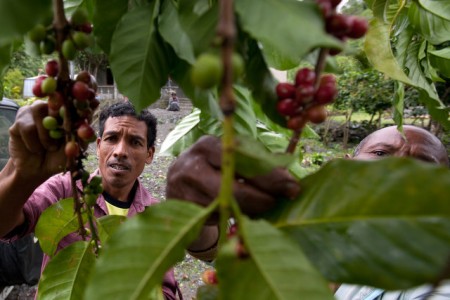
May 4th, 2012_ LACLUBAR, TIMOR-LESTE_ Residence of the mountain town of Laclubar, pick organic Timor Arabica coffee cherry at the start of the harvest season. Coffee is an important agricultural crop for the residence of this remote mountain village. Photographer: Daniel J. Groshong/The Hummingfish Foundation

Laclubar is a remote village in the country of Timor-Leste and is home to some of Timor’s best organic Arabica coffee.

Due to the remote nature of Laclubar, its residence are not able to gain access to Timor’s thriving coffee industry.

The Hummingfish Foundation is working on a project which will support the coffee farmers of Laclubar, by assisting them in the purchase of several hand operated de-pulping machines, some material which can be used to build drying racks and perhaps the construction of a central warehouse, where farmers can store the coffee after processing.

The mission of MMCC is to grow, process, brand and export the world’s best coffee.  With the THF model giving back 100% of proceeds to the community, we can add value to the organic method of coffee production and transform the lives of the people through greater economic opportunity.

Secondly, new export products can also be branded and marketed under the Maubere Mountain name to add more income to the community, diversify their export products and better utilize infrastructure investments.

First cupping of Maubere Mountain Coffee

On the 10th of July, 2012, Maubere Mountain Coffee was professionally cupped and the results are better then expected.

Mr. Shane McCarthy who worked in the coffee business in Timor-Leste for 8 years and Mr. Dixon Ip, SCAA Cupping Judge and CQI Grader, cupped Maubere Mountain coffee in Hong Kong and rated our coffee above the 80th percentile compared to coffees worldwide.

Mr. Ip said Maubere Mountain Coffee “has a pleasant acidity, a light body, clean cup flavor.

Mr. McCarthy, who specializes in tasting defects in coffee determined that Maubere Mountain Coffee was “very nice and free of defects.”

We have to offer a special thanks to Colour Brown Coffee in Sai Kung, Hong Kong for hosting the cupping event and for being such a great friend to Hummingfish!!

Maubere Mountain Coffee

In December of 2011, The Hummingfish Foundation (THF) a non-for-profit organization from Hong Kong with strong ties to Timor-Leste, started working with village leaders in the Batara Suco of the Laclubar sub district in Timor-Leste, to help them create a high-end brand of boutique coffee.  Laclubar is a remote village isolated from the world, which grows what some experts, such as Mr. Billy Lee, Hong Kong’s biggest trader of single origin coffee (800 tons per year), believe to be a potentially world class coffee.  The problem is, that there is a total lack of proper coffee processing available on site and the road conditions to Laclubar make it impossible to get their coffee to a processing facility in time to ensure a quality product.

On the 4th of May, 2012, THF and 23 village leaders and representatives from Laclubar signed their names to a document agree to form the Maubere Mountain Coffee Cooperative (MMCC), which is committed to producing commercial quantities of a high end boutique coffee called Maubere Mountain Coffee (MMC).

Story
Coffee was first introduced to Timor-Leste by the Portuguese Governor, Vitorino Freire da Cunha Gusmao in 1815.  By 1860, coffee had already become a part of Timorese daily lives and dominated their export economy.  Tens of thousands of Timorese have provided for their families over the years as a result of our coffee industry.  However, since the Indonesian occupation of Timor-Leste in 1975, the organic Arabica coffee from the Laclubar region has been sold as low grade coffee at the lowest prices.  Since independence from Indonesia in 1999, Timor Arabica coffee has once again claimed notoriety around the world as one of the best organic Arabic coffees available anywhere.  Traders from all over the world are veiying to purchase Timorese coffee, but despite the fact that Laclubar has perhaps the best coffee growing in Timor today, poor processing methods and bad road conditions have had an end result of producing some of the worst coffee in Timor-Leste and excluding the people of Laclubar in the potential profits associated with the international coffee trade.

May 3rd 2012_ LACLUBAR, TIMOR-LESTE_ Residence of the mountain town of Laclubar, inspect a new hand pulping machine donated to them by The Hummingfish Foundation. The pulper is part of an organic coffee farmer support project, designed to improve the farmer's coffee and create a high end brand as well. Photographer: Daniel J. Groshong/The Hummingfish Foundation

THF is working with MMCC to create the necessary infrastructure, production methods, branding & marketing and sales channels to maximize profits for the community and adding value to the organic methods in which MMC is produced.

With a successful coffee business, the people of Laclubar will have a financial incentive to continue with their organic coffee production, rather then be tempted to adapt the production of other destructive, non-organic crops.  With successful marketing of the MMC brand name, other products will be possible for the people of Laclubar, such as Maubere Mountain Honey, Maubere Mountain Peanut butter, etc.

Mission
The mission of MMCC is to grow, process, brand and export the world’s best coffee.  With the THF model giving back 100% of proceeds to the community, we can add value to the organic method of coffee production and transform the lives of the people through greater economic opportunity.

Secondly, new export products can also be branded and marketed under the Maubere Mountain name to add more income to the community, diversify their export products and better utilize infrastructure investments.

Objectives
The objectives of MMCC are the following:

  • Determine the best coffee processing method or methods for MMC
  • Add value to organic coffee production for the residents of Laclubar.
  • Building a production facility to be used during the coffee processing season and for the production of other products the rest of the year
  • Development of high-end brand unique to Laclubar.
  • Construction of a website dedicated to Maubere Mountain Coffee with buy function
  • Wholesale and retail distribution of Maubere Mountain Coffee brand.
  • Winning the World Cup of Excellence award.
  • Reduction of poverty for residence of Laclubar.
  • Diversify products from Laclubar to include items such as Maubere Mountian Honey, Maubere Mountain Peanut butter, etc.
  • Total sales for coffee, honey and peanut butter reaching sales of $21,000 per monthly within 5 years (100% of profits are paid back to MMC).
  • Organic certifications for coffee, honey and peanut butter.
  • Transition the Ai-Funan Cooperative to a fully-fledged, independently run Timor-Leste registered business.

Needs
Timing is vital to the success of the MMCC project.  Now that the community is committed to creating a high-end brand of coffee and other products, we must give them support as soon as possible.  This first year is dedicated to testing several methods for processing MMCC’s coffee.  Technical assistance by coffee experts will ensure that the method or methods chosen for the processing are as perfected as possible. Once the processing methods have been determined, an investment into the infrastructure will be needed to scale the production up over several years.  More technical assistance is recommended for the processing and engineering challenges to build the processing infrastructure will need to be met.

For the production of other products, such as honey and peanut butter, some additional infrastructure, research and development, branding & marketing will be helpful in creating these products.

Finally, assistance will be needed to help secure organic and fair trade certifications for MMCC’s export products.

First visit to Laclubar

Please take a moment to view our photo gallery of images form the Laclubar area.

Please take a moment to view our photo gallery of images form the Laclubar area.

On the 18th of October Hummingfish Director Daniel J. Groshong drove the back breaking road to the heart of Timor-Leste to visit the remote village of Laclubar.  Laclubar is the home to some of Timor’s best organic Arabica coffee, which is normally taken to market over the mountains on horseback.

The Hummingfish Foundation is working on a project which will support the coffee farmers of Laclubar, by assisting them in the purchase of several hand operated de-pulping machines, some material which can be used to build drying racks and perhaps the construction of a central warehouse, where farmers can store the coffee after processing.

Finally, Hummingfish would like to help the people of Laclubar create a coffee brand specific to their coffee and culture, which will add value to their hard work producing some of the world’s best coffee.

Please take a moment to view our photo gallery of images form the Laclubar area.

About Timor Coffee

Timor-Leste, Asia’s newest nation, is famous around the world for its coffee.

Tens of thousands of coffee farmers make their living from coffee production each year. It is far and away Timor’s largest agricultural export product and the country’s largest employer.

Timor was recently rated #10 in the world for organic agriculture by Newsweek Magazine. Agricultural experts with many years of experience in Timor-Leste suggest that the entire country is effectively chemical fertilizer and pesticide free.  Supporting Timor’s agricultural sector and encouraging them to keep out destructive farming practices is extremely important to the Hummingfish Foundation.

It was recently brought to the foundation’s attention that some rural communities which are growing this world-famous Arabica coffee have recently been cut off from the market due to poor road conditions and a relatively small yield. This makes it impossible for the usual coffee traders to justify spending the costs associated with buying coffee from these areas.

Rather then take the risk of these farmers losing their way of life, or even worse, being tempted to introduce chemical fertilizers and pesticides, the Hummingfish Foundation has started a project where we buy the coffee from these Timorese farmers and sell that coffee directly to the consumer, excluding any “for profit” middle-men.

The Hummingfish Foundation also sees great potential for “Coffee Tourism” in the highlands of Timor-Leste, due to the majestic unspoiled beauty of Timor’s mountains and the close bond developed between the consumers and  the communities growing the coffee they love to drink.

If you like their coffee, you will love their coffee plantations.

A brief history of coffee in Timor-Leste

August 28, 2001-Monatari, East Timor-A woman carries a basket on her head while picking coffee in the hills near the tiny village of Manotari located on the road between Maubissi and Ainaro. Coffee is one of East Timor's only experts at the moment. Photograph by Daniel J. Groshong/Tayo Photo Group

Coffee, as a crop, was first planted in 1815 by the innovative Portuguese Governor of that time, Vitorino Freire da Cunha Gusmao. By 1860 coffee had become so important to the economy that all village headmen or “Liurais” were ordered to grow coffee and expected to give 20% of their harvest to the Portuguese authorities. By the early 1860s coffee dominated the export economy, replacing sandalwood as the country’s most economically important commodity. Coffee has remained the principal export earner ever since, and is only now being dislodged from that position by Liquid Petroleum Gas extracted from the Timor Sea.

Until 1897 the country’s coffee was produced entirely by smallholders, however in that year, under the direction of the Portuguese Governor, a man named Jose Celestino da Silva established a coffee plantation of some 9,000ha in the highland Ermera District. Together with three other landowners as partners, he established the large agricultural company, Sociedade Agricola Patria e Trabalho (SAPT). The SAPT was converted into a joint stock company when Celestino left the colony in 1908. By World War II, due to several financial crises, Japanese interests owned 40% of SAPT, the Bank Nacional Ultramarino (BNU) owned another 8%, while the remaining shares were held by descendents of the original founder, Governor da Silva. However, smallholders continued to dominate export production right through the 19th and 20th centuries, and the plantations – representing mainly foreign interests – were never economically successful, and only remained viable through the protection given to them by the colonial state.

AUGUST 8TH 1999-DILI, EAST TIMOR-A Polling worker peers out from a polling station, while the shadow of a voter is cast on the wall. The vote for East Timor's independence was overwhelmingly in favor. Photo by Photo by Daniel J. Groshong/Tayo Photo Group

With the Indonesian occupation of East Timor in December 1975, the Indonesian military were given control of, among other economic commodities, coffee. They were also given control of the venerable SAPT, which at that point was forced to change its name to become P.T. Denok, with a controlled group of mainly military and “First Family” Indonesian shareholders. Unfortunately, their interest in the crop lay only in its opportunities for revenue generation. It was not until 1994 that, with the assistance of the Governor of East Timor the military monopoly was broken, and the American but internationally-based National Cooperative Business Association (NCBA), commenced operations to quality process and market the country’s annual coffee harvest with USAID funds. The NCBA also returned to the grower farm families a reasonable price for their efforts, based on the ever-shifting international indicator prices for coffee.

Portuguese Timor’s Arabica coffee has always been considered to be of high quality and has always fetched good prices. From the 1890s to the 1930s, coffee exports regularly topped the 1,000 ton mark, and sometimes went above 2,000 tons. However, from the 1890s to the 1930s, coffee exports stagnated, but continued to dominate the colony’s economy; mainly because prices fell on a world market flooded by Brazilian overproduction. Although the colony’s economy was brought to a virtual standstill during World War 2, coffee production expanded during the post-war boom. In 1955-‘63, coffee accounted for 73% of exports by value, a figure which rose to over 90% in 1970-73, and is 95% today (exclusive of re-exports and oil revenues). (MAF 2009)

SEPTEMBER 21ST 1999-DILI, EAST TIMOR- Timorese refugees who have been hiding in the mountains for up to one month hold an East Timorese flag and shout with happiness at the arrival of a photographer. Photo by Daniel J. Groshong/Tayo Photo Group

Pressured by the U.S. Government, the Indonesian Government allowed the existing monopoly in the Timor-Leste coffee sector to be broken in 1994 by allowing representatives of the NCBA to begin working in the sector. Coffee producers were given an option on how they might sell their coffee: through the cooperative, which began paying a farm gate price that reflected the prices the NCBA could obtain in the open market; through more familiar channels into the Indonesian market or through several other buyers based in West Timor. Producers enjoyed the benefits that competition brought to the marketplace (the price paid for coffee increased fourfold in the first week of the NCBA buying in 1994), and the amount of coffee being sold through the NCBA steadily increased, to the point that the total amount of coffee produced in Timor-Leste was expected to exceed 10,000 tonnes/year by 1999. The opportunity to increase the cash supplement to their subsistence existence captured the interest of the farmers and motivated them to increase output. (Moxham, Pomeroy)

IIn the wake of the destruction and political turmoil of 1999, the NCBA continued to work with what was left of the Indonesian cooperative system. A structure of 16 local organisations known as Cooperativa Cafe Organic (CCO) were established under the umbrella of the Cooperativa Cafe Timor (CCT) (Moxham). With the re-commencement of purchasing, processing, sales and export operations during the 2000 season, CCT became the only significant purchaser of coffee. (Oxfam 2003)


Some information about Timorese coffee

Coffee is Timor-Leste’s leading export commodity, with an estimated 52,000ha of coffee gardens. In 2008, the total production of coffee (as green beans) was estimated by MAF to be 14,000 tonnes of which 12,500 tonnes was exported.

2008 was an excellent production year due to good and reliable rainfall. This increased total production to 14,000 tonnes of green bean coffee compared to 10,500 tonnes in the previous year (2007).

The 2004 census results showed that about 50,000 families rely on coffee for a substantial share of their cash income and another 15,000 families rely on coffee for a minor share.

Farmers in East Timor have plantings of both Arabica and Robusta coffees, both of which are well-suited to the natural conditions and climate of the country. Shade trees such as Casuarina junghuhniana and Paraserianthes falcataria (formerly Albizzia falcataria) are used widely to provide the necessary protection from direct sunlight and wind.

The real advantage of Timorese coffee was a gift of nature, when some time in the latter half of the 19th century a hybrid occurred between the highland Arabica and the lowland Robusta coffees, miraculously providing in a single plant the best qualities of both species, particularly a resistance in the tree to the very common and harmful problem of fungal “rust” infections.

The main production districts in order of importance are Ermera, Ainaro, Aileu, Manufahi, Liquica and Bobonaro (Lolotoi). Ermera accounts for half of Timor-Leste’s coffee production.  The main production districts in order of importance are Ermera, Ainaro, Aileu, Manufahi, Liquica and Bobonaro (Lolotoi). Ermera accounts for half of Timor-Leste’s coffee production.

Coffee is harvested between May and September. Harvesting is not continuous but occurs in three stages – the initial stage (lelesan), middle stage (panen besar) and final stage (racutan). The first stage involves collection of dry and damaged cherries, the middle is when the bulk of harvest occurs, and the final stage is devoted to picking the few remaining ripe, green and fallen cherries to break pest and disease cycles. In the unmanaged conditions of East Timor, many coffee trees are very tall and this poses difficulties for farmers. So much time is spent picking cherries, that little time is available for grading cherries to take out unripe or diseased ones; this contributes to a low quality of green bean.

August 28, 2001-Monatari, East Timor-Ripe Coffee in the hills near the tiny village of Manotari located on the road between Maubissi and Ainaro. Coffee is one of East Timor's only experts at the moment. Photograph by Daniel J. Groshong/Tayo Photo Group

Coffee is picked as a ripe cherry; the cherry may be processed on-farm or by buyers who prefer to control all the steps in processing at a central processing plant to ensure the best possible quality for the coffee. The first step is to remove the fleshy outer layer of the cherry, called ‘de-pulping’. Step two involves washing and drying the de-pulped bean into ‘parchment’. During this first step, it is critical to have good drying conditions so that the parchment does not start to ferment and become ‘musty’, as this affects the final taste and therefore the quality of the coffee. The dried parchment then has the remaining skins of the coffee bean removed so that only the green bean remains. It is this green bean that is roasted to produce the roasted coffee bean that is used to prepare a brew of coffee. Nearly all coffee exported from Timor-Leste is exported as green bean, although some exports of parchment are also sent to Indonesia for processing.

Coffee is traded as dry green beans, referred to as hulled (beras) or makt coffee, after removal of flesh and skins. There are two systems of processing: dry processing or Oost Indische Bereiding (OIB) and wet processing or West Indische Bereiding (WIB). Some farmers use the dry processing system where the cherry is picked and dried under the sun for 10 days and then stored until it is powdered and sold. The wet processing system in general is handled by larger processing plants, such as Cooperativa Café Timor (CCT). Since the purchasing power of CCT is limited (20–30% of the crop), not surprisingly, many farmers prefer to process their own coffee beans using the wet processing system. This process follows a procedure of collecting cherries, sorting, pulping, fermenting, washing, drying and sorting again, often in a traditional way using an open hole which allows contamination and loss of quality.

About six kg of ripe cherries yield one kg of parchment and one kg of dry parchment will provide about 500 grams of green bean. The ratio of parchment to cherry and green bean to parchment determines the relative prices paid for purchasing cherry or parchment from farmers (Table 6). Of course there are costs associated with de-pulping the cherry and drying the parchment and for processing parchment into green bean. Unless the coffee is to be consumed on the farm, farmers always sell either cherry or parchment to buyers. Some farmers are able to use a local pulping machine for this processing, although the end product is often still poor, because the parchment is not sufficiently washed to remove the mucilage, which will eventually effect the cupping quality of the coffee, and consequently lower the international price offered.

It is important in processing, after separation of the flesh and skin, that coffee beans are dried to an optimum moisture content of 13 to 15%, as above this range, moulds are a risk and below it, breakages may occur.

The quality market is about 40% of the total export market (5,000 tonnes in 2008); the lower quality market is around 60% of the market (or 7,500 tonnes). There are therefore significant opportunities to improve the quality of Timor-Leste coffee exports, irrespective of any increase in the volume of coffee produced. Using data for 2005, it can be seen that the U.S.A. is the principal destination for coffee exports (43% by volume), followed by Germany (29%), and Indonesia (13%). However, it is likely that Singapore is now a major export destination since nearly all Timor Global’s coffee is now exported through that country; although Singapore is certainly not the final destination.

Timor-Leste’s future as a coffee exporter is best served by targeting the specialty and quality market. This market offers premium prices and the organic, fairtrade and specialty coffee market is predicted to grow more than the conventional sector.  Timor coffee is now a hot commodity, selling at an all-time high on the global market. The NCBA alone produced about 18,500 tons of cherries or about 4,000 tons of green bean in 2010. (MAF 2009)


Share
This entry was posted in Past Posts, Projects, Projects-Archive, Projects-Timor-Leste. Bookmark the permalink.

Leave a Reply

Your email address will not be published. Required fields are marked *

*

You may use these HTML tags and attributes: <a href="" title=""> <abbr title=""> <acronym title=""> <b> <blockquote cite=""> <cite> <code> <del datetime=""> <em> <i> <q cite=""> <strike> <strong>

*
= 3 + 6